
The new National Planning Policy Framework (NPPF) replaces the previous document in full and, in my opinion, represents a positive step forward. At Tate + Co, our work with SME housing developers, local authorities and design-led regeneration projects means that several of the proposed changes are particularly welcome. While planning is only one of the barriers projects face, I believe the following measures could make a meaningful difference.
This article includes excerpts from the Ministry of Housing, Communities & Local Government’s document issued in August 2026.
Good thing number one – A stronger presumption for planning consent within settlements
There are two policies here which really help this. The first is the pretty self-explanatory Policy-S4: Principle of Development within settlements:
)

This is clearly more positive than the previous NPPF and should strengthen the position when trying to get consent for infill sites. It is further strengthened by Policy-L2 making effective use of land:
)
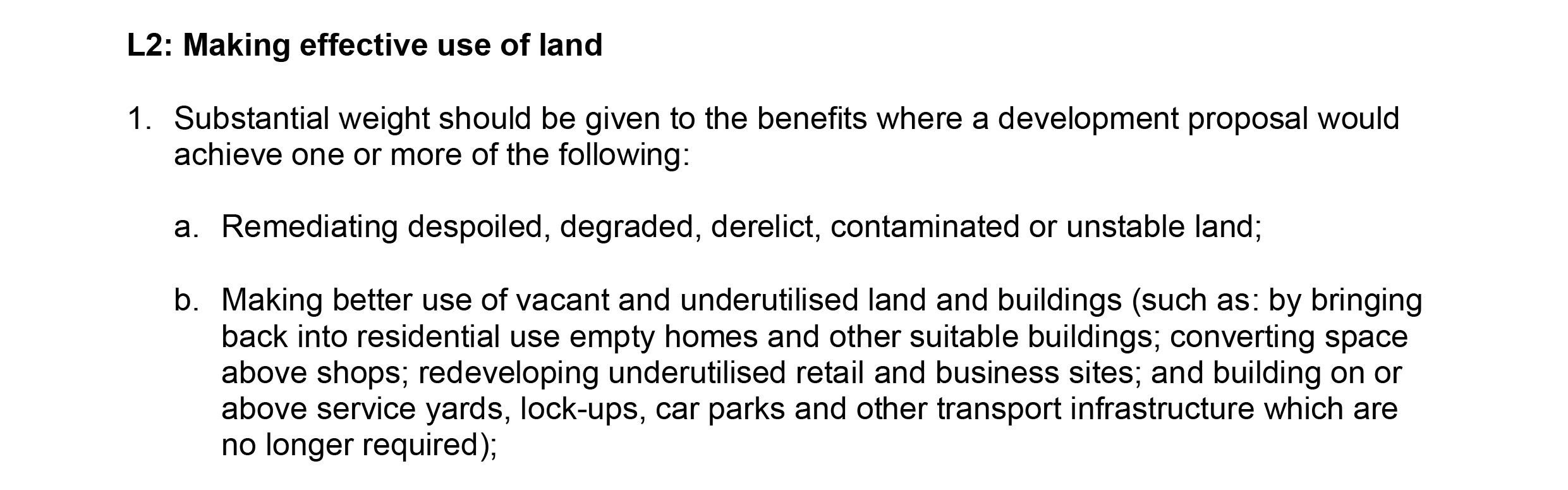
Which essentially means that there has to be very significant barriers to development on underutilised urban gap sites, and if not then the Local Authority should be minded to consent. Whilst this has realistically (kind of) always been the case it is useful to have it explicitly stated.
Good thing number two – Better policies for small sites and SME Developers
Whilst there has previously been a requirement for Local Authorities to make sure that 10% of their housing allocation is on sites of less than one hectare, there is now a new requirement that an additional 10% should be dedicated to sites of one to two and a half hectares in Policy-HO6.
)

With the same scale in mind, there is a new definition in the NPPF Glossary of a ‘medium’ site:
)

However, the ‘Medium’ developments are still technically classified as ‘Major’ and the only reference to it in the body of the NPPF is in Policy-DM2 which asks that Local Authorities think about scale in relation to validation requirements:
)
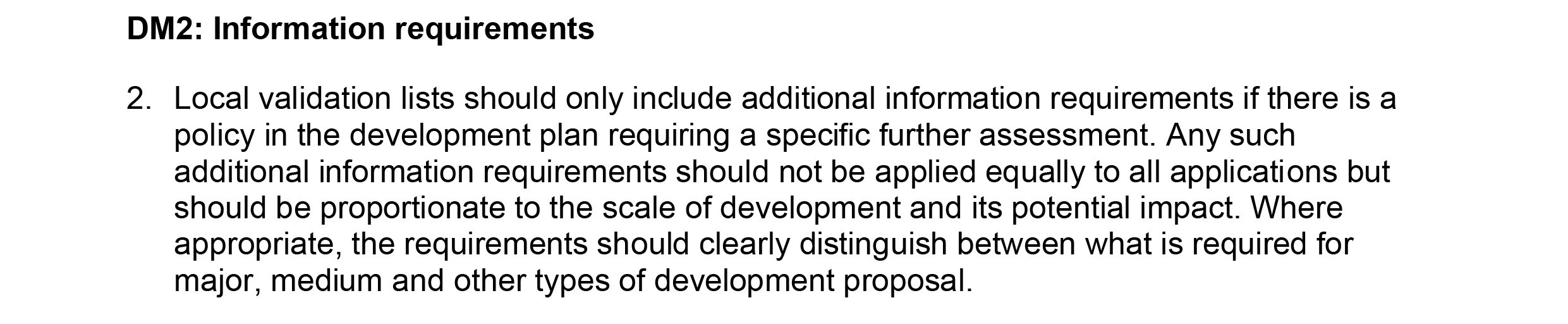
And then, although it does not explicitly refer to ‘Medium’ as a scale, Policy-DM3 states that authorities should take a proportionate approach when determining applications:
)
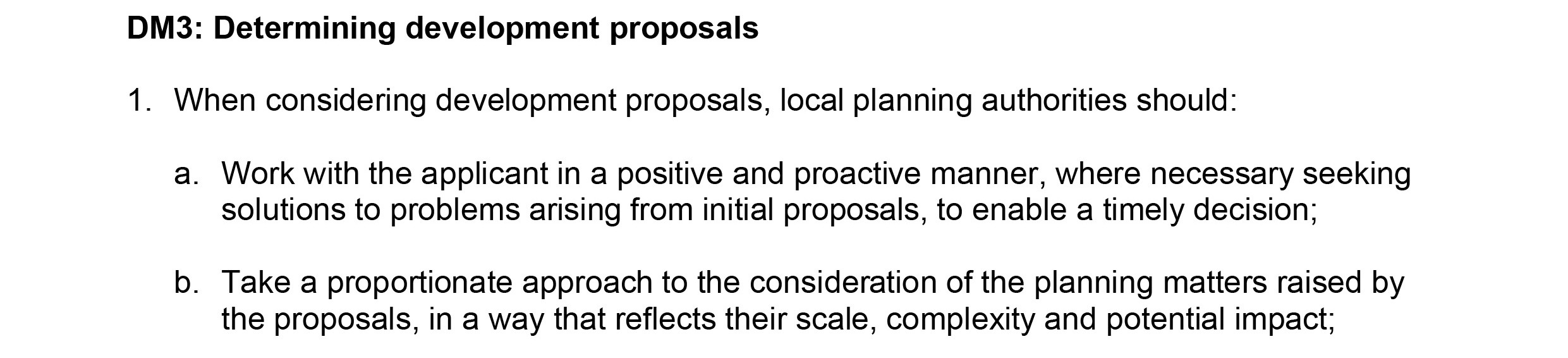
A lot of our clients are building developments in this ‘Medium’ category of between 10 to 49 homes and are falling between two stools in terms of the policy and regulatory requirements they need to meet, many of which in aggregate are challenging at this scale. My hope is Local Authorities interpret DM2 and DM3 to make intelligently balanced planning decisions for projects at a ‘Medium’ scale.
Good thing number three – New opportunities near Railway Stations
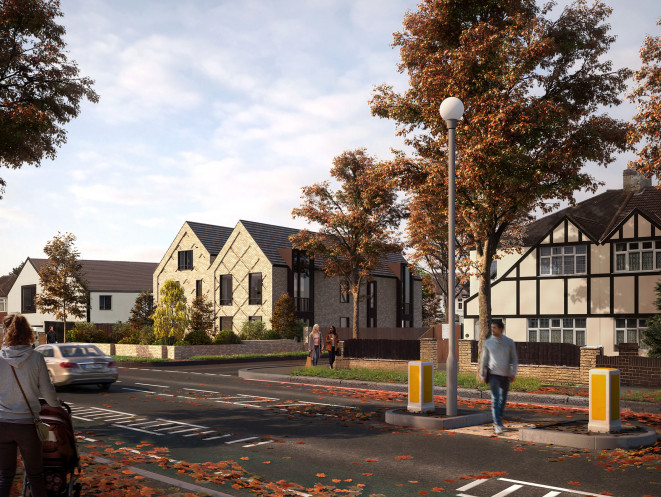
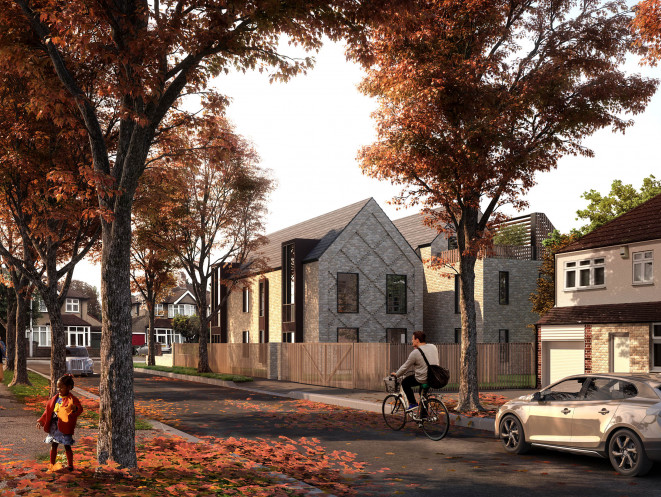
There is a really interesting opportunity which is a new policy supporting residential development near well-connected railway stations under Policy-S5, subsection H(i):
)
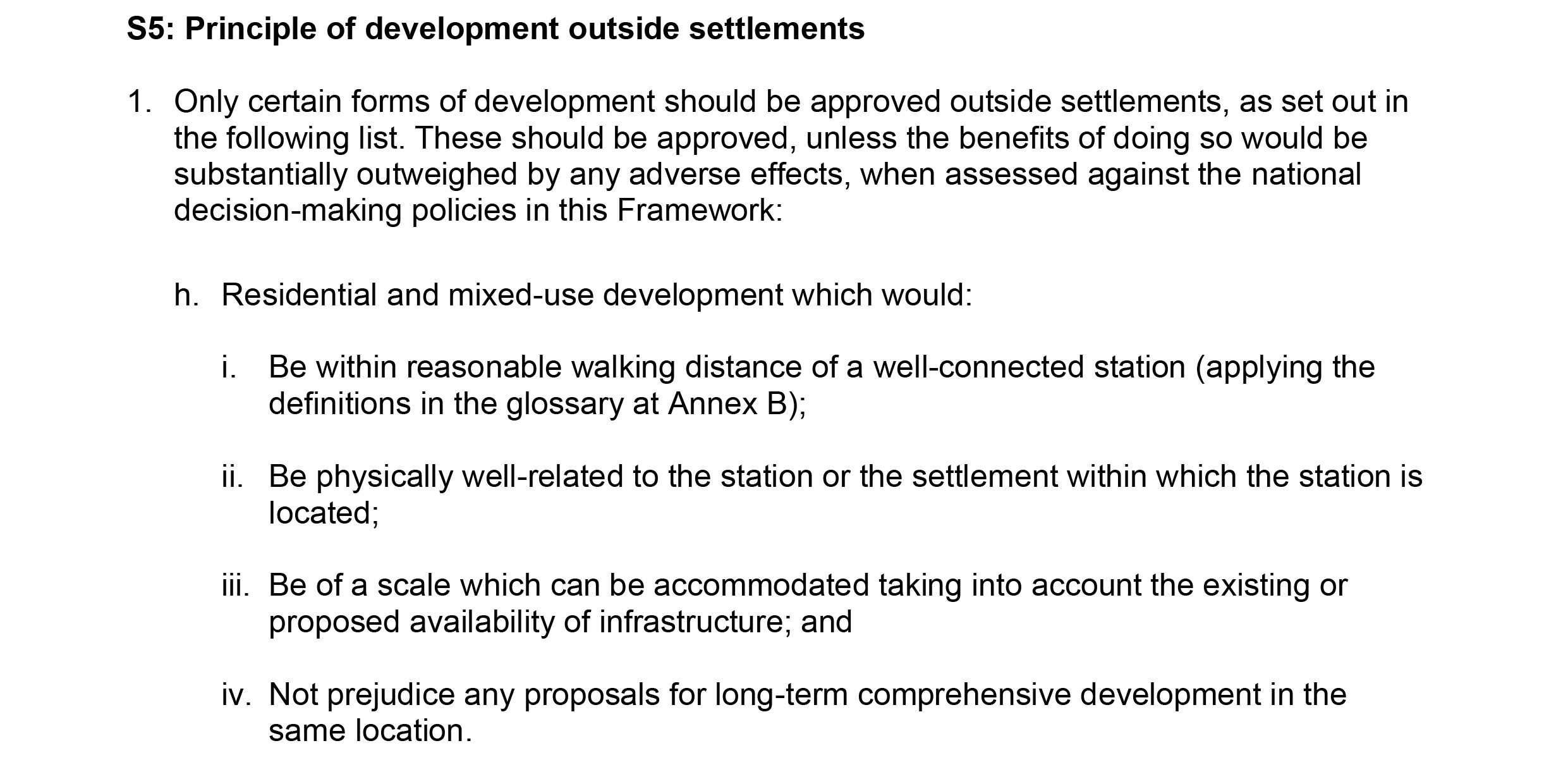
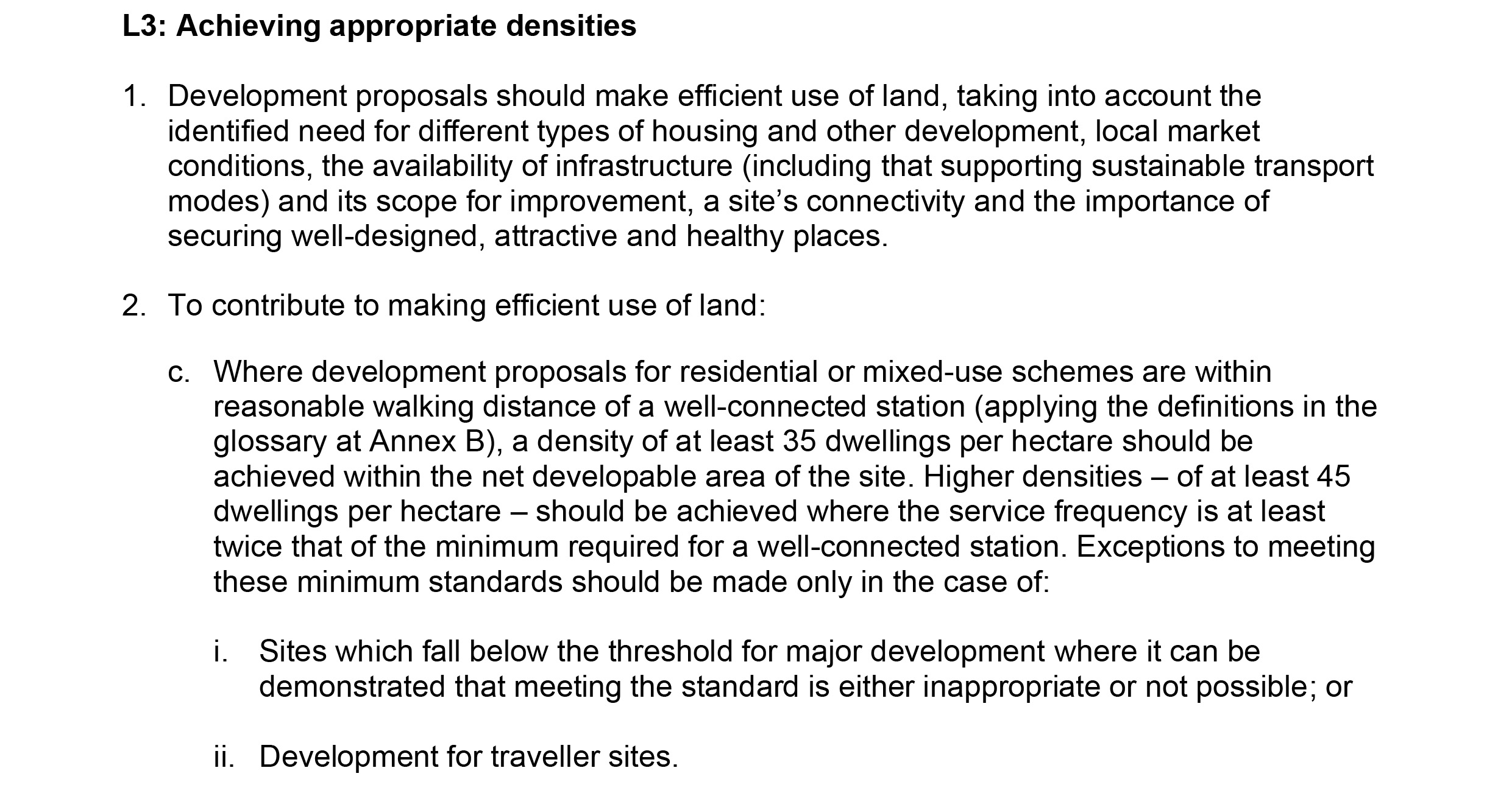
To be specific, they define ‘reasonable distance’ as 800 metres or a ten minute walk (in Annex B), while Policy-L3 sets out a required density of at least 35 dwellings per hectare around stations and 45 dwellings per hectare around high-frequency stations:
)
)
)
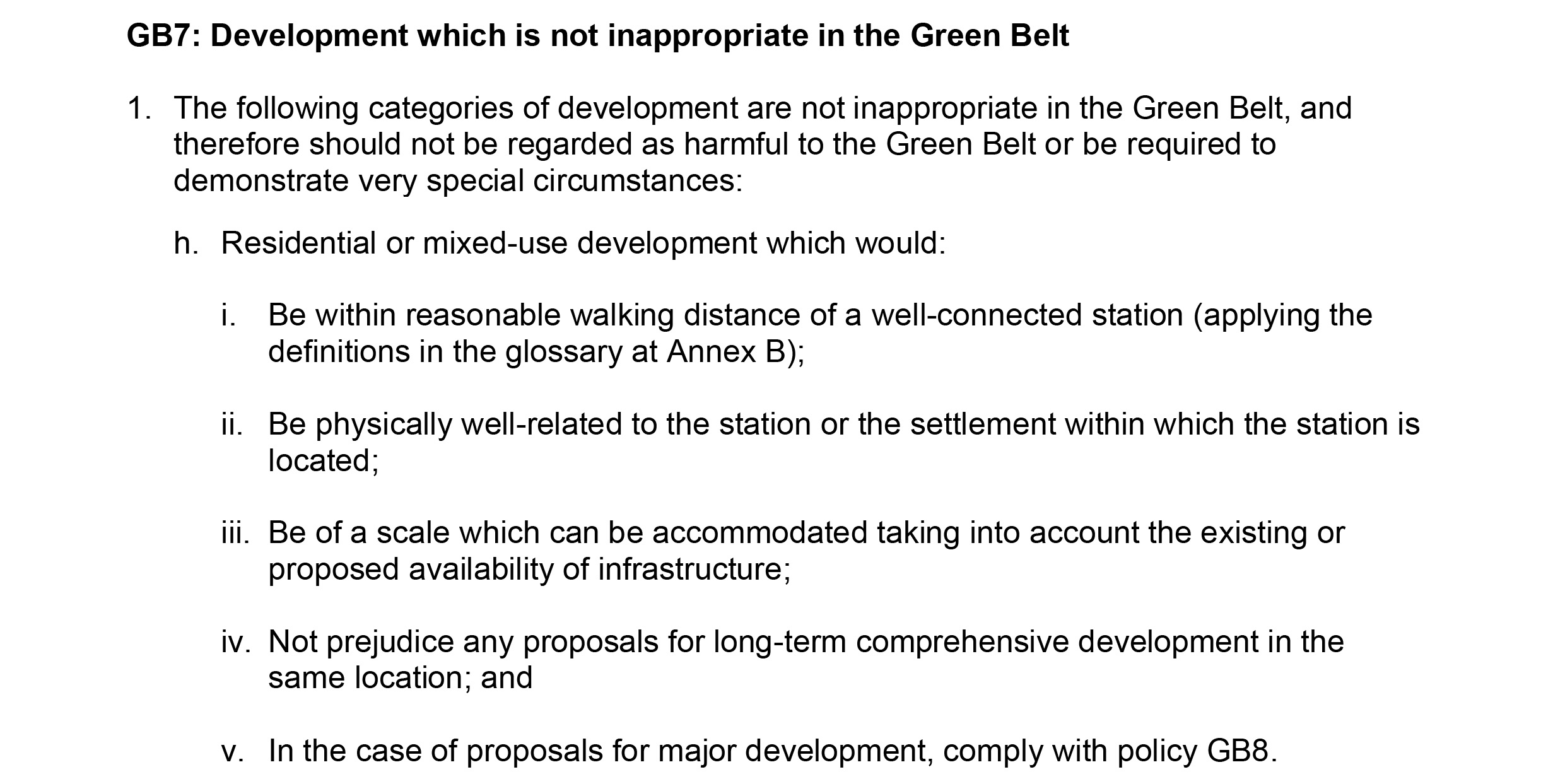
Building on this approach, the new NPPF also gives a route to gaining consent in the Greenbelt near a station under Policy GB7 subsection H:
)
So overall this opens up a lot of new potential sites for housing development located next to stations (i.e. strategically sensible) locations. This could present a fresh series of development opportunities moving forwards.
Good thing number four – Regenerative Design gets more emphasis
OK so there is no specific reference to Regenerative Design, but there are three policies which are very much aligned with the philosophy. Policy-CC2 explicitly encourages the reuse of existing structures and materials, resource conservation and low-carbon energy, whilst given substantial weight to improving the energy efficiency of existing buildings.
)
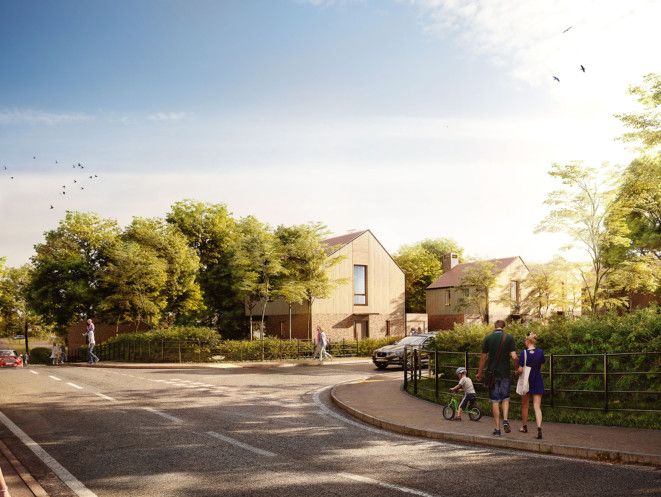
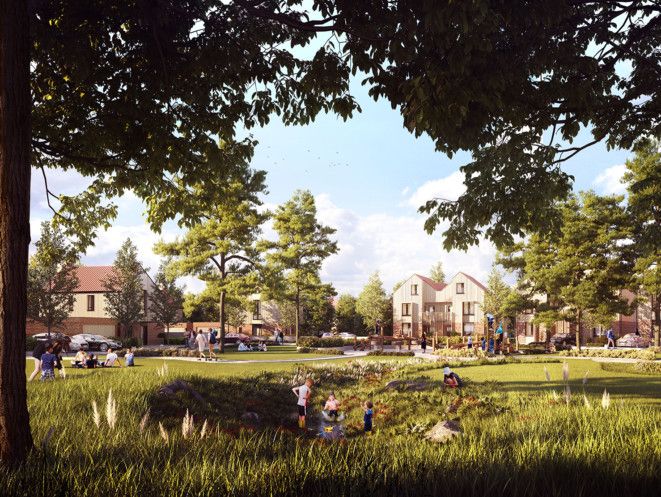
Alongside this, Policies N1 and N2 strengthen the role of Local Nature Recovery Strategies, ecological networks, green infrastructure and nature-based solutions. There is a lot in these policies but broadly they are setting out very sensible strategies for ensuring developments make the most of existing nature on and around a site and also exploit as many opportunities as possible for nature recovery. At Tate + Co we think that a real connection to nature can greatly benefit both the quality and the ‘bottom line’ of a development so these policies really align with our values.
)
Conclusion – A step in the right direction
I have picked out here the elements of the new NPPF that I think directly relate to our clients, and I have to say that overall there is a positive direction from this policy document. It has clear aims to make better use of existing land and buildings, deliver more homes on smaller sites, intensify sustainably around infrastructure, and create places that are increasingly resilient, nature-positive and low carbon. It will be very interesting to see how this all gets interpreted at a local level, and my hope is that it unlocks some more sites to build the high-quality sustainable homes we so desperately need in the UK.
)
)

Jerry Tate
Director

Jerry founded Tate+Co in 2007 and maintains a central role at the practice. He is driven by his desire to generate creative, pragmatic and unique solutions for each project that have a positive impact on our built and natural environment. Jerry is influential across all projects, ensuring design quality is paramount.
Jerry was educated at Nottingham University and the Bartlett, where he received the Antoine Predock Design Award, subsequently completing a masters degree at Harvard University, where he received the Kevin V. Kieran prize. Prior to establishing Tate+Co, he worked at Grimshaw Architects where he led a number of significant projects including ‘The Core’ education facilities at the Eden Project in Cornwall, UK.
Jerry is an active member of the construction industry community and is a fellow of the Royal Society of the Arts. He is frequently invited to lecture, notably at Education Estates, the Carpenters Fellowship and Ecobuild, as well as contribute to architecture publications, including the Architects Journal, Building Design, Sustain, and World Architecture News. He has taught at Harvard University, run a timber design and make course for the Dartmoor Arts organisation and was Regnier Visiting Professor for Kansas State University’s Architecture School in 2021/22. Currently Jerry teaches at the Bartlett School of Architecture, UCL. In his spare time Jerry is involved with a number of charities and is a trustee at the Grimshaw Foundation as well as a Governor at Cranleigh School.